|
The official standard for the Tibetan Terrier was established with the AKC and approved on march 10, 1987, The standard is stated as follows: |
|
Head-Skull = Medium length neither broad nor coarse. The length from the eye to the tip of the nose is equal to the length from the eye to the occiput. The skull narrows slightly from ear to eye. It is not domed but not absolutely flat between the ears. The head is well furnished with long hair, falling forward over the eyes and foreface. The cheekbones are curved but not so overdeveloped as to bulge. Muzzle = The lower jaw has a small amount of bread. Stop = There is a marked stop but not exaggerated. Nose = Black. Teeth = White, strong, and evenly placed. There is a distinct curve in the jaws between the canines. A slightly undershot bite is acceptable. Eyes—Large, set fairly wide apart, dark brown and may appear black in color, neither prominent nor sunken. Eye rims are dark in color. Ears = pendant, falling not too close to the head, heavily feathered with “V” shaped leather proportionate to the head. Faults = Weak pointed muzzle. Any color other than black nose. Overshot bite or a very undershot bite or a wry mouth. Large narrow head. Lack of fall over the eyes and forehead. Neck and Body Neck = Length proportionate to the body and head. Body = Compact, square and strong, capable of both speed and endurance. Topline = the back is level in notion. Chest = Heavily furnished. The brisket extends downward to the top of the elbow in the mature Tibetan Terrier. Ribs = The body is well ribbed up and never cloddy of coarse. The rib cage is not too wide across the chest and narrow slightly to permit the forelegs to work free at the sides. Loin = slightly arched. Tail = Medium length, heavily furnished, set on fairly high and falls forward over the back, may curl to either side. There may be a kink near the tip. Forequarters—Shoulders = Sloping, well muscled and well laid back. Legs = Straight and strong when viewed from the front/ Heavily furnished. The vertical distance from the withers to the elbows equals the distance from the elbows to the ground. Feet—The feet of the Tibetan Terrier are unique from other dogs. They are large, flat and round in shape producing a snowshoe effect that provided traction, The pads are thick and strong. They are heavily furnished with hair between the toes and pads. Hair between the toes and pads may be trimmed level with the underside of the pads for health reasons. The dog should stand well down on the pads. Dewclaws = may be removed. Hindquarters-Legs = Well furnished, with well bent stifles and the hind legs are slightly longer than the forelegs. Thighs—Relatively broad and well muscled. Hocks = Low set and turn neither in nor out. Feet = Same as forefeet. Dewclaws = May be removed. Coat = Double coat. Undercoat is soft and wooly. Outer coat is profuse and fine but never silky of wooly. May be wavy of straight. Coat is long but should not hang to the ground. When standing on a hard surface an area of light should be seem under the dog. The coat of puppies is shorter, single and often has a softer texture than that of adults. A natural part is often present over the neck and back.
For more information check out the www.akc.org
|
|
Breed Standard |
|
Chance Tibetan Terriers |

|
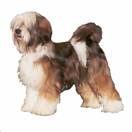
The Tibetan Terrier is a medium-sized dog, profusely coated, of powerful build and square in proportions. A fall of hair covers the eyes and foreface. The well-feathered tail curls up and falls forward over the back. The feet are large, flat and round in shape producing a snowshoe effect that provides traction. The Tibetan Terrier is well balanced and capable of both strong and efficient movement. The Tibetan Terrier is shown as naturally as possible. |
|
Contact US at |